Friday, August 28, 2009

CIA Documents Provide Little Cover for Cheney Claims

Washington Independent 

Documents Fail to Exonerate 'Enhanced Interrogation' Techniques

By Spencer Ackerman

Former Vice President Dick Cheney (Associated Press) For months, former Vice President Dick Cheney has said that two documents prepared by the CIA, one from 2004 and the other from 2005, would refute critics of the Bush administration's torture program. He told Fox's Sean Hannity in April:

"I haven't talked about it, but I know specifically of reports that I read, that I saw, that lay out what we learned through the interrogation process and what the consequences were for the country," Cheney said. "I've now formally asked the CIA to take steps to declassify those memos so we can lay them out there and the American people have a chance to see what we obtained and what we learned and how good the intelligence was."

Those documents were obtained today by The Washington Independent and are available here.  Strikingly, they provide little evidence for Cheney's claims that the "enhanced interrogation" program run by the CIA provided valuable information. In fact, throughout both documents, many passages — though several are incomplete and circumstantial, actually suggest the opposite of Cheney's contention: that non-abusive techniques actually helped elicit some of the most important information the documents cite in defending the value of the CIA's interrogations.

Illustration by: Matt MahurinThe first document, issued by the CIA in July 2004 is about the interrogation of 9/11 architect Khalid Sheikh Mohammed, who was waterboarded 183 times in March 2003 and whom, the newly released CIA Inspector General report on torture details, had his children's lives threatened by an interrogator.  None of that abuse is referred to in the publicly released version of the July 2004 document. Instead, we learn from the July 2004 document that not only did the man known as "KSM" largely provide intelligence about "historical plots" pulled off from al-Qaeda, a fair amount of the knowledge he imparted to his interrogators came from his "rolodex" — that is, what intelligence experts call "pocket litter," or the telling documentation found on someone's person when captured. As well, traditional intelligence work appears to have done wonders — including a fair amount of blundering on Khalid Sheikh Mohammed's part:

In response to questions about [al-Qaeda's] efforts to acquire [weapons of mass destruction], [Khalid Sheikh Mohammed] revealed that he had met three individuals involved in [al-Qaeda's] program to produce anthrax. He appears to have calculated, incorrectly, that we had this information already, given that one of the three — Yazid Sufaat — had been in foreign custody for several months.

This is a far cry from torturing Khalid Sheikh Mohammed into revealing such information. It would be tendentious to believe that the torture didn't have any impact on Khalid Sheikh Mohammed — he himself said that he lied to interrogators in order to get the torture to stop — but the document itself doesn't attempt to present a case that the "enhanced interrogation" program was a factor, let alone the determinant factor, in the intelligence bounty the document says he provided.

http://washingtonindependent.com/56344/cia-documents-provide-little-cover-for-cheney-claims

Sphere: Related Content

Why Craigslist Is Such a Mess

by Gary Wolf
 
http://www.wired.com/images/article/magazine/1709/ff_craigslist_f.jpg
Craigslist founder Craig Newmark.

The Internet's great promise is to make the world's information universally accessible and useful. So how come when you arrive at the most popular dating site in the US you find a stream of anonymous come-ons intermixed with insults, ads for prostitutes, naked pictures, and obvious scams? In a design straight from the earliest days of the Web, miscellaneous posts compete for attention on page after page of blue links, undifferentiated by tags or ratings or even usernames. Millions of people apparently believe that love awaits here, but it is well hidden. Is this really the best we can do?

Odd perhaps, but no odder than what you see at the most popular job-search site: another wasteland of hypertext links, one line after another, without recommendations or networking features or even protection against duplicate postings. Subject to a highly unpredictable filtering system that produces daily outrage among people whose help-wanted ads have been removed without explanation, this site not only beats its competitors—Monster, CareerBuilder, Yahoo's HotJobs—but garners more traffic than all of them combined. Are our standards really so low?

But if you really want to see a mess, go visit the nation's greatest apartment-hunting site, the first likely choice of anybody searching for a rental or a roommate. On this site, contrary to every principle of usability and common sense, you can't easily browse pictures of the apartments for rent. Customer support? Visit the help desk if you enjoy being insulted. How much market share does this housing site have? In many cities, a huge percentage. It isn't worth trying to compare its traffic to competitors', because at this scale there are no competitors.

Each of these sites, of course, is merely one of the many sections of craigslist, which dominates the market in facilitating face-to-face transactions, whether people are connecting to buy and sell, give something away, rent an apartment, or have some sex. With more than 47 million unique users every month in the US alone—nearly a fifth of the nation's adult population—it is the most important community site going and yet the most underdeveloped. Think of any Web feature that has become popular in the past 10 years: Chances are craigslist has considered it and rejected it. If you try to build a third-party application designed to make craigslist work better, the management will almost certainly throw up technical roadblocks to shut you down.

http://www.wired.com/entertainment/theweb/magazine/17-09/ff_craigslist?currentPage=all
 
Sphere: Related Content

No Ordinary Fad

http://www.lamag.com/images/top-logo.jpg
 
Making sense of the Beatles, whose music has been digitally re-mastered and featured in a new video game

Someone once noted that, other than Shakespeare, the Beatles may be Western culture's only instance of the best and the most popular being the same thing. It's not hard to imagine 500 years from now people questioning, as they have with Shakespeare's plays, how four young working-class guys with no training could have made so much music so varied and so consistently first-rate in less than a decade, evolving at a pace that would exhaust amoebas. It may take U2 five years to produce an album, but only 38 months (five albums, more than 70 songs) separated the Beatles' winningly naive "I Want to Hold Your Hand" and the nuclear Debussy of "Strawberry Fields Forever," which sounded like nothing else in 20th-century pop before or after. Shakespeare didn't have a digital age to bear witness, but the reissue this month—for the first time since the mid-'80s—of the Beatles' work on CD not only verifies the scope of their accomplishment but snatches it from the noisy distractions of their mystique.

Two different audiences for the Beatles exist. For anyone much over 50 the Beatles' impact was so massive, it still feels immediate; that this music was made nearly half a century ago is an invitation to mortal terror. Those under 50 must groan at the mere mention of the band let alone the oppressive cast of its shadow. It doesn't hurt, then, to remember the messy beginning, acknowledging there does seem something slightly supernatural about it, particularly when you consider that in the early '60s, the post-World War II U.K. was crawling with such bands. The Beatles themselves existed in other incarnations early on, first as the Quarrymen, then the Moondogs, erratically numbering five or six who always included John Lennon, Paul McCartney, and George Harrison. They were the bottom of the barrel. On the Liverpool circuit Richard Starkey, aka Ringo Starr, the seaport's hottest drummer and coveted by the Beatles until they landed him for their first album, was the bigger star. Surrounding the band is a bit of the Robert Johnson legend, having to do with a '30s Mississippi singer-guitarist of no special faculties who disappeared one night and returned at dawn the greatest blues artist of all time, a deal with the Devil in his back pocket. Not competent enough to get a gig in their hometown, the Beatles decamped to the ash heaps of Germany, playing among the strippers in depraved hellholes where pickpockets worked the crowd, then returned a few months later to Liverpool in Robert Johnson style as the greatest band of all time, to the astonishment of anyone who remembered them.

Hometown triumph notwithstanding, the band's records were released in the United States to indifference a year before a momentous television appearance on The Ed Sullivan Show. In retrospect the performance was less impressive than boomer memory allows. McCartney trilled songs from The Music Man, the big Broadway show of the day. So the new CD reissues are a testament to what no 21st-century skepticism can assail: If the band's second album, With the Beatles (released in England on the day of John Kennedy's assassination), was a powerhouse consolidation of their gifts, the Brit version of A Hard Day's Night just four months after the American breakthrough, timed to coincide with a witty, irrepressible movie, was the quantum leap that put any doubters in their place. It was the first album on which the band, mostly Lennon and McCartney, wrote everything, demonstrating the freshest melodic sense since Puccini. The singing was almost as spectacular.

With A Hard Day's Night, the Beatles began to assert their individual personalities as they continued cohering into a single superpersonality. This was a gestalt no other band ever has quite replicated, with talents, viewpoints, and temperaments overlapping and complementing one another. McCartney and Lennon shared the loss of orphans, McCartney's mother taken by cancer and Lennon's run over by a cop (which must have cemented his antiauthoritarian tendencies), and each responded in ways that distinguished him, McCartney with plucky opportunism, Lennon with pain and rage. Growing up the youngest of four siblings, Harrison again found himself the "kid" whose frequent dismissal by a new set of older brothers only drove him to prove something. Starr, the product of a broken marriage and a childhood of crises (in a coma at the age of six, then a sanatorium for two years of his adolescence), had learned not to take too much too seriously. What he couldn't give the band in vision he supplied in professionalism, perspective, and bonhomie. These were four psyches in the kind of lucky alignment that any Vegas slot machine pays off in millions.

http://www.lamag.com/article.aspx?id=19036

Sphere: Related Content

Marijuana Compounds May Offset Alcohol-Induced Toxicity, Study Says

 http://www.enewspf.com/templates/ja_teline_ii/images/logo.gif

San Diego, CA--(ENEWSPF)--August 27, 2009. Compounds in cannabis may protect the human brain against alcohol-induced damage, according to clinical trial data published online by the journal Neurotoxicology and Teratology.

Investigators at the University of California at San Diego examined white matter integrity in adolescents with histories of binge drinking and marijuana use.

They reported that binge drinkers (defined as boys who consumed five or more drinks in one sitting, or girls who consumed four or more drinks at one time) showed signs of white matter damage in eight separate regions of the brain.

By contrast, the binge drinkers who also used marijuana experienced less damage in seven out of the eight brain regions.

"Binge drinkers who also use marijuana did not show as consistent a divergence from non-users as did the binge drink-only group," authors concluded. "[It is] possible that marijuana may have some neuroprotective properties in mitigating alcohol-related oxidative stress or excitotoxic cell death."

http://www.enewspf.com/index.php?option=com_content&view=article&id=9776:marijuana-compounds-may-offset-alcohol-induced-toxicity-study-says-&catid=88888904&Itemid=88890249

Sphere: Related Content

1,000 cameras 'solve one crime'

Only one crime was solved by each 1,000 CCTV cameras in London last year, a report into the city's surveillance network has claimed.

CCTV camera in the Embankment, central LondonThe internal police report found the million-plus cameras in London rarely help catch criminals.

In one month CCTV helped capture just eight out of 269 suspected robbers.

David Davis MP, the former shadow home secretary, said: "It should provoke a long overdue rethink on where the crime prevention budget is being spent."

He added: "CCTV leads to massive expense and minimum effectiveness.

"It creates a huge intrusion on privacy, yet provides little or no improvement in security.

"The Metropolitan Police has been extraordinarily slow to act to deal with the ineffectiveness of CCTV."

Nationwide, the government has spent £500m on CCTV cameras.

 http://news.bbc.co.uk/2/hi/uk_news/england/london/8219022.stm

Sphere: Related Content

China admits death row organ use

British Broadcasting Corporation

Chinese criminals are sentenced to death in Wenzhou, file image
China executes more people than any other nation

China is trying to move away from the use of executed prisoners as the major source of organs for transplants.

According to the China Daily newspaper, executed prisoners currently provide two-thirds of all transplant organs.

The government is now launching a voluntary donation scheme, which it hopes will also curb the illegal trafficking in organs.

But analysts say cultural bias against removing organs after death will make a voluntary scheme hard to implement.

Thriving black market

About 1.5 million people in China need transplants, but only about 10,000 operations are performed annually, according to the health ministry.

The scarcity of available organs has led to a thriving black market in trafficked organs, and in an effort to stop this the government passed a law in 2007 banning trafficking as well as the donation of organs to unrelated recipients.

But in practice, illegal transplants - some from living donors - are still frequently reported by the media and the Ministry of Health.

http://news.bbc.co.uk/2/hi/asia-pacific/8222732.stm

Sphere: Related Content

Democratic Health Care Bill Divulges IRS Tax Data

http://i.i.com.com/cnwk.1d/i/cbs/blogs/CBSNews_bloghd_taking_liberties_630x63.jpg
 
 
One of the problems with any proposed law that's over 1,000 pages long and constantly changing is that much deviltry can lie in the details. Take the Democrats' proposal to rewrite health care policy, better known as H.R. 3200 or by opponents as "Obamacare." (Here's our CBS News television coverage.)

Section 431(a) of the bill says that the IRS must divulge taxpayer identity information, including the filing status, the modified adjusted gross income, the number of dependents, and "other information as is prescribed by" regulation. That information will be provided to the new Health Choices Commissioner and state health programs and used to determine who qualifies for "affordability credits."

Section 245(b)(2)(A) says the IRS must divulge tax return details -- there's no specified limit on what's available or unavailable -- to the Health Choices Commissioner. The purpose, again, is to verify "affordability credits."

Section 1801(a) says that the Social Security Administration can obtain tax return data on anyone who may be eligible for a "low-income prescription drug subsidy" but has not applied for it.

Over at the Institute for Policy Innovation (a free-market think tank and presumably no fan of Obamacare), Tom Giovanetti argues that: "How many thousands of federal employees will have access to your records? The privacy of your health records will be only as good as the most nosy, most dishonest and most malcontented federal employee.... So say good-bye to privacy from the federal government. It was fun while it lasted for 233 years."

I'm not as certain as Giovanetti that this represents privacy's Armageddon. (Though I do wonder where the usual suspects like the Electronic Privacy Information Center are. Presumably inserting limits on information that can be disclosed -- and adding strict penalties on misuse of the information kept on file about hundreds of millions of Americans -- is at least as important as fretting about Facebook's privacy policy in Canada.)

A better candidate for a future privacy crisis is the so-called stimulus bill enacted with limited debate early this year. It mandated the "utilization of an electronic health record for each person in the United States by 2014," but included only limited privacy protections.
 
http://www.cbsnews.com/blogs/2009/08/26/taking_liberties/entry5268079.shtml
 
 
Sphere: Related Content

Obtained: The RNC’s Health Care Survey

Washington Independent

By David Weigel

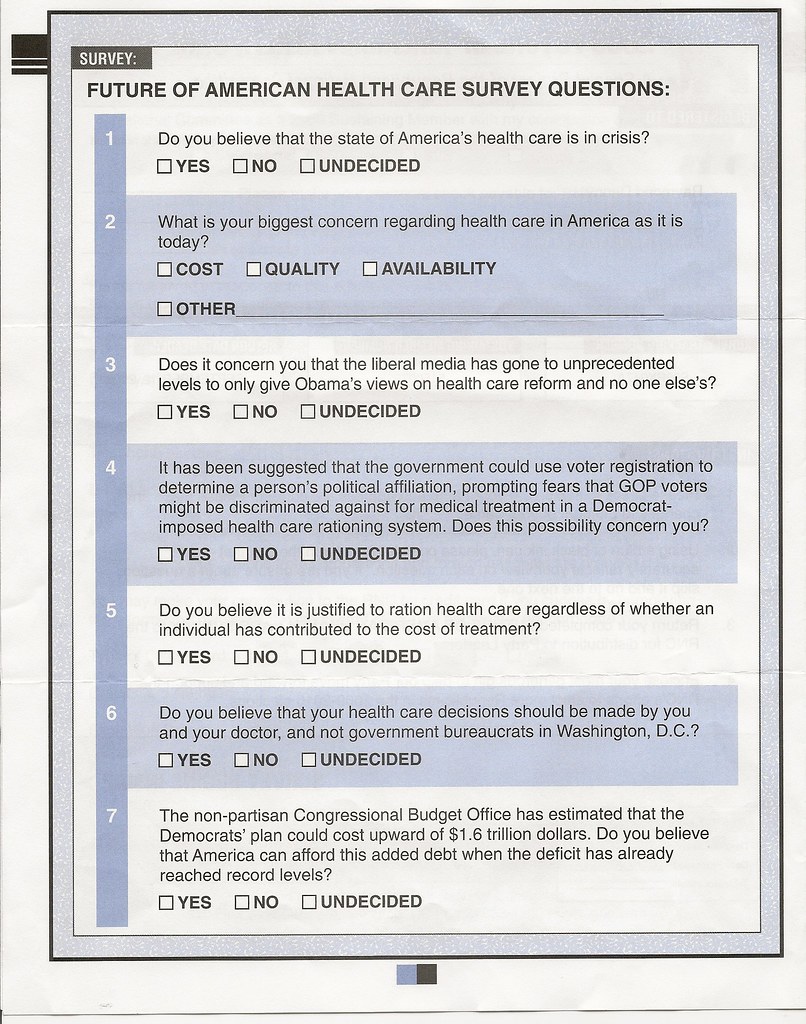
I just chatted with Raymond Denny, the 64-year-old La Center, Wash., man who received the RNC's "2009 Future of American Health Survey," which alleged that President Obama's health reform plans might discriminate against Republicans. Here's the survey question:

Picture 59

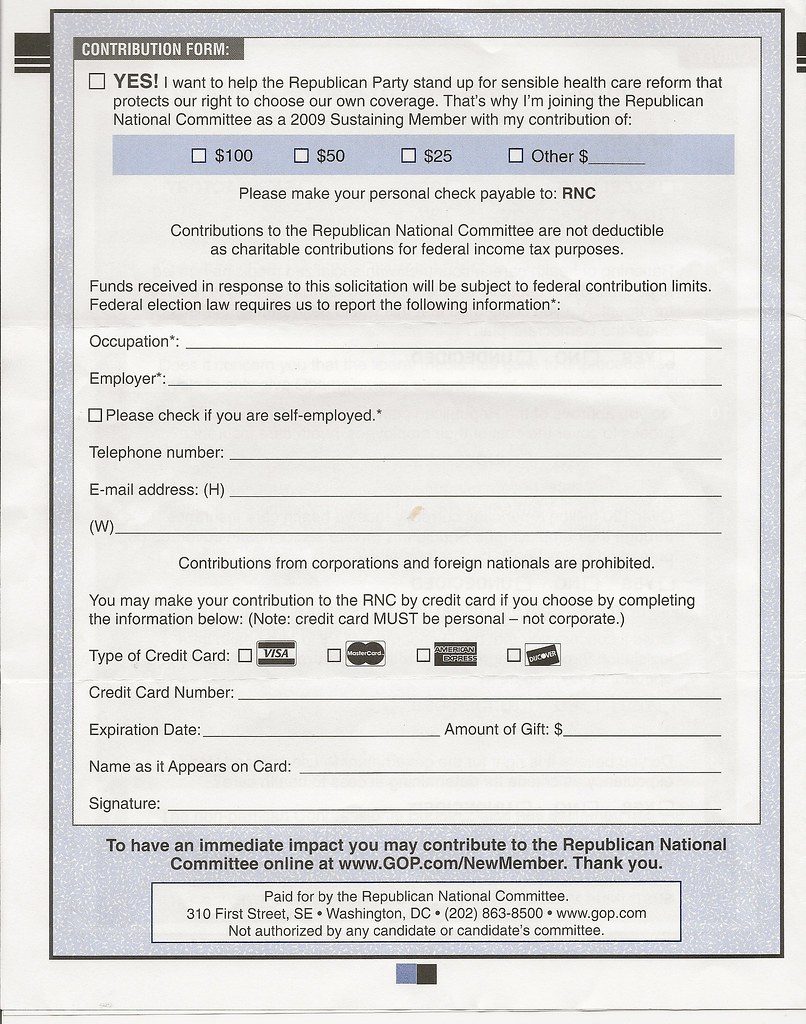
"I've been getting these things for years," said Denny, who opened the letter with his wife Louise, "getting them from the Republicans, getting them from the Democratic Party, usually with the wrong name on it. This thing says I'm a sustaining member. They word these things to solicit the answer they wanted. This one here we looked at and said, "Wow, that's way beyond the pale of what should be done."

Denny confirmed that he's a "lifelong independent" who became a Democrat last year to vote for Obama. "I'm a fiscal and constitutional conservative," he said, although he hasn't made up his mind on the health care debate yet. "I don't know why I got this. Maybe something in my demographic or something convinced them that I was a lifelong Republican."

Click on the pages below to see larger .jpg images of them.

http://washingtonindependent.com/56844/obtained-the-rncs-health-care-survey

Sphere: Related Content

Health Care Reform: lessons from Sicko


by Kathleen Kelly

Denied.

You're denied.

You don't qualify for health care insurance.  What do you do now?  Or you have health insurance but once you become ill, your insurance company's loopholes can and will negate your coverage.

Medical bills are now the number one cause of bankruptcy and homelessness in America.  These daunting statistics are what keep me running circles (literally) on the elliptical at the gym.  Is is that I enjoy running and going nowhere? No, I'm fearful.  Scratch that, I'm petrified that I will become ill--that like my father I will become obese, have Type II diabetes, and experience complications from high blood pressure.  It's maddening since there are illnesses (cancer, Parkinson's, Alzheimer's) and accidents for that matter that I have no control over.  If the current healthcare system in the United States was about providing acute, quality care for patients, I could rest easy.  But let's be honest, it's about the bottom line, it's emblematic of capitalism--it's about money and the millions that health insurance and pharmaceutical companies earn each minute of the day on the pain and suffering of average Americans.

Michael Moore's 2007 documentary "Sicko" is reminiscent of "Roger and Me"--the story of David (in this case, everyday working Americans) versus Goliath (the insurance companies and pharmaceutical giants--think Kaiser Permanente, Blue Cross, Blue Shield, and PhRMA).  What Moore stresses in this provocative, captivating, and historicizing account of how the American healthcare system got "off its rails" and privatized (in 1971 while we were in the midst of Vietnam--Albert Kaiser, Richard Nixon, and the Oval Office--you get the picture) is that not only do the 48 million uninsured in this country not have access to affordable let alone effective healthcare, the insured among us are living under the false security that no matter what ailments we suffer, we are "covered"; that we have access to all tests and treatments to improve our quality of life.

Guess again.  Moore casts a caustic light on the objectives and end goals of health insurance companies.  In his interview with Becky Malke, a health insurance consultant, the truth of the matter is damning to say the least.  It was her role to "weed out" the customers.  There are a multitude of conditions--the number would wrap around Becky's house many times according to this industry insider--that would exclude you from qualifying for health insurance.  And preexisting conditions--you can forget about healthcare coverage.  Just ask Maria Watanabe (Maria Watanabe vs. Blue Shield of California) whose surgery cost reimbursements were denied because she had failed to disclose a previous yeast infection.  If the treatment is "experimental" that will save your life, you'll denied access to this treatment.  If you condition is not deemed "life threatening" as in the case of a cancer survivor, who was not insured and seeking treatment since her cancer had returned; she was told to take some ibuprofen and go home.  Sarah Palin and Senator Charles Grassley (R-Iowa) egregiously and irresponsibly speak about the nonexistent and fabricated (yes, nonexistent and fabricated) "death panels" in "Obamacare." Mrs. Palin, Mr. Grassley--look around you.  Avoidable deaths are rampant in the current, broken, and yes, corrupted system.  Cease and desist with your fear-mongering.

Michael Moore addresses such fear-mongering and lobbying within the throes of the 1994 President's Task Force on Healthcare headed by then FLOTUS Hillary Rodham Clinton.  Hillary demanded universal health coverage, a demand that was met with fierce, wrathful and condemnatory criticisms--Hillary was trying to unleash the "red menace" into God-fearing, capitalist America.  She was a Bolshevik, a statist, just call her Comrade Clintonovska.  Moore's voice becomes deflated though as he relates the cautionary tale of Hillary Rodham Clinton--once feared (not loved) by the health insurance industry, in her bid for the New York Senate seat, allied herself with the very people she had opposed only years earlier.  She and her political campaign profited from the unethical antics of this money-grubbing industry.

But surely even such a corrupted system would take care of our nation's heroes--heroes like the volunteer emergency responders who worked relentlessly at Ground Zero after the 9/11 attacks.  How did the U.S. health care system and politicians honor our heroes?  These volunteers were denied health care benefits and treatments for illnesses they sustained while working in the ruins of what were the World Trade Center towers.  John Graham, Willam Maher, and Ms. Reggie Cervantes were first responders whose ailments are debilitating--pulmonary fibrosis, post traumatic stress, and severe respiratory illnesses.  Yet these volunteers were denied health care coverage. As volunteers, the government maintains, they were not employees. Therefore, these emergency responders were ineligible for health care benefits, benefits paramount to their recovery from their individual illnesses.

Michael Moore, accompanied by Mr. Graham, Mr. Maher and Ms. Cervantes, sets out on his own "freedom flotilla" from Miami to Guatanamo Bay to acquire the same medical treatment that the enemy combatant detainees were receiving (minus the torture presumably).  Denied access to Gitmo, Moore and his compadres enter the Havana Hospital (yes, that Havana--the one in Cuba).  The inhalers and medications are so much cheaper in Cuba--Reggie's inhaler that costs $120 in the U.S. costs mere pocket change in Cuba.  John is able to get tests and scans that he could ill afford in the U.S. and the Cuban doctors provided him with a daily regimen; and Bill, having once ground his teeth down during his PTS-induced sleep, had a new set of teeth both set and fit.  His was a welcomed smile.  The land of Castro had come to our heroes' rescue.  Hmmm. . . . it makes you rethink those ill notions of socialized medicine, doesn't it?

http://www.examiner.com/x-5324-Sacramento-Movie-Examiner~y2009m8d14-Health-Care-Reform-lessons-from-Sicko

Sphere: Related Content

Don't Get Sick!

by Gail Pellett

photo    Don't get sick! Those were the last words my grandfather said to me as I left Vancouver for the United States. It was 1964. Canada was in the process of implementing a universal health care system. I hadn't noticed, because I was young, healthy and restless.

    Now, these many years later, as I witness the health care reform "debate," my grandfather's words have returned to haunt me. He had been a pioneer farmer in Saskatchewan on the Canadian prairies. That's where Canada's universal health care system was conceived during the hard years of the depression and its aftermath.

    Medicare (Canada's health care plan) was largely the brainchild of a Baptist minister turned politician, T. C. (Tommy) Douglas. He and others founded a new party in Saskatchewan (which later became the New Democratic Party) based on "humanity before private interests." Universal health care was at the top of their agenda. By 1964, Saskatchewan implemented a health care plan that treated everyone according to their needs regardless of their ability to pay. Despite a doctor's strike that tried to kill it, the farmers - including my grandfather - made sure that this new health care plan survived. Then, just as now, there were those who thought it made total sense and others who thought it was a Communist conspiracy. However, it proved so popular in Saskatchewan that within a few years the federal government adopted it for the entire country. Imagine the audacity of this during a raging cold war. The year the plan went into effect was the year of the Cuban missile crisis.

    In 2004, the Canadian Broadcasting Corporation conducted a poll to determine whom Canadians thought was the greatest Canadian of all time. It was not Pierre Trudeau, Joni Mitchell, Dan Aykroyd, Leonard Cohen, Margaret Atwood, Lorne Michaels, Oscar Peterson, Peter Jennings, Celine Dion, Neil Young, Keanu Reeves, nor Wayne Gretzky. It wasn't even Keifer Sutherland or his dad, Donald. No, it was Keifer Sutherland's grandfather, Tommy Douglas, who is credited with making sure that Canadians would have universal, government-funded health care. When Canadians are periodically polled and asked what they are most proud of, in addition to peacekeeping, it is their national health care system.

http://www.truthout.org/082709A?n

Sphere: Related Content

We distort! You comply!

Sphere: Related Content

Thursday, August 27, 2009

Liberal

Sphere: Related Content

Does President Obama have the guts?

Could she have been right when she said that he was the candidate of lofty promises —"the skies will open, the light will come down, celestial choirs will be singing and everyone will know we should do the right thing and the world will be perfect" — and not the candidate of real leadership?

In her former life as a presidential candidate, Clinton warned voters that Obama would let them down. She warned them that when the going got tough, he would fold up.

She said it was not just a matter of Obama lacking experience — that was the least of it — but that he lacked the strength, the toughness, the will to get the job done.

In January 2008, at Nashua High School North just before the New Hampshire primary, Clinton said of Obama: "I applaud his incredible ability to make a speech that really leaves people inspired. My point is that when the cameras disappear and you're there in the Oval Office having to make tough decisions, I believe I am better prepared and ready to lead our country."

Democratic voters disagreed with her (though she did win New Hampshire), and Obama went on to win both his party's nomination and the presidency. But Clinton, now his secretary of state, left him with a warning: "You campaign in poetry, but you govern in prose."

It is prose time for Obama.

And we are now going to see how he governs when it comes to meaningful health care reform. In his heart and in his head he knows what it takes for such reform. He knows that a public option — a government-run health care program like Medicare — has the best chance of competing with the insurance industry.

Sphere: Related Content

The end of Camelot

Sphere: Related Content

Zero Hedge Claims that the Federal Reserve ITSELF Traded Over a Trillion Dollars Worth of Derivatives in March Alone

You know Zero Hedge, the popular website which has broken major stories like Goldman's dominance of high-frequency trading.

Some say that Zero Hedge occasionally breaks stories before adequately fact-checking them. I don't know whether that is true or not, but I do know that - in the months I've been reading the site - ZH has broken a number of major stories which:

(1) Were later covered by the world's biggest financial news outlets

and

(2) Have caused Congress members, Senators, the New York Stock Exchange and others to take action to change reporting requirements and to shut down questionable practices

Zero Hedge is now claiming that the Federal Reserve itself traded over a trillion dollars worth of derivatives in March alone:

Federal Reserve Disclosed Trading $1.4 trillion in OTC "Other" Derivatives in March 2009 *corrected

Federal Reserve Does Derivatives

The Federal Reserve has apparently been engaged in OTC derivatives trading. As of March 2009, they began publishing this information in several categories broken down by 'risk'. Tyler discovered this bombshell last Friday. In Treasury TIC data there are large sums classified as "Other Contracts". While it is not clear what specifically is being traded , we know these are not "Single-currency Interest Rate Contracts" nor are they "Foreign Exchange Contracts". These contracts are classified as "Other Contracts by Type of Risk" -- and they include $85 billion in OTC equity derivatives , and $1.169 trillion (yes, with a T) in OTC credit derivatives.


What is interesting here is that prior to March 2009 such trading was not reported in detail. The March disclosure by category is what is completely new. These Fed OTC derivatives have $1 trillion+ in capital in "Other". It is unclear what aspect of the credit capital markets this is allocated to or propping up: is it CDS? And if so, what entities are the contracts written on? At this time, it is unclear what relationship, if any, these $1.4 trillion in Federal Reserve OTC derivatives have to the unusual market activity many of us have been observing.

If Zero Hedge is right about this one, it will end up being one of the biggest stories of the year.

See this.


http://georgewashington2.blogspot.com/2009/08/zero-hedge-claims-that-federal-reserve.html

Sphere: Related Content

Insurers admit 50,000 employees lobbying Congress to claim profits fair

By John Byrne

Memo tells employees to keep a low profile

A spokesman for America's Health Insurance Plans, the industry's trade group, admitted in an article published Monday that as many as 50,000 industry employees are involved in an effort to fight back against aggressive healthcare reform.

The admission, published in the last sentence of a Wall Street Journal article, highlights the stakes of potential healthcare reform for the private health insurance industry. Insurers and investors alike are terrified at the prospect of a so-called "public option," which would create a government-run health insurance program to compete with private insurers. Because the government plan wouldn't have to earn a profit, the plan would be able to undercut the premiums of private firms, pressuring profit margins.

"The health-insurance industry is sending thousands of its employees to town-hall meetings and other forums during Congress's August recess to try to counter a tide of criticism directed at the insurers and remain a player — and not an outsider — in the debate over the future of the health-care system," the Journal's Vanessa Fuhrmans and Avery Johnson wrote Monday.

http://rawstory.com/08/news/2009/08/24/health-insurance-employees-lobbying-congress/

Sphere: Related Content

PETA Wants to Buy Lighthouse as a Fish Empathy Center

by Erik Deckers

I think PETA is getting into comedy, because their latest caper just screams hilarity.

They want to buy the Grand Haven lighthouse on Lake Michigan as its new anti-fishing campaign headquarters and memorial center, says the Detroit News. PETA applied to take over the lighthouse through a federal program that allows nonprofits to take control of the country's lighthouses as a way for the federal government to reduce operating costs.

"We want to renovate the Grand Haven lights as a memorial to the billions of fish killed annually by sport fishermen, as well as for their flesh (commercial fishing industry)," said Lindsey Rajt, manager of PETA's campaigns department. "We also want to make it a fun and educational place."

Muh-huh.

You know, I'm thinking we need a grain empathy center to commemorate the billions of tons of grains killed to make the granola PETA loves so much. We'll build it in an abandoned barn I saw a couple hours north of Indianapolis. And we'll start a similar one for a soybean memorial center for all the tofu they've preyed upon over the years.

http://laughing-stalk.blogspot.com/2009/08/peta-wants-to-buy-lighthouse-as-fish.html

Sphere: Related Content

The torch

Sphere: Related Content

The Fast Food Industry's 7 Most Heinous Concoctions


Some of America's favorite chains have concocted some thoroughly repellent dishes that make the Double Quarter Pounder look like a celery stick.
 

Although the organic movement has certainly started to influence how Americans think about their food, it is still no match for the American fast food industry, which continuously finds creative new ways of piling sugar, salt and fat on a plate and charging customers $4.99 for the privilege of eating it.

In recent years, in fact, some of America's favorite chains have gone above and beyond the call of duty and concocted thoroughly repellent dishes that make the Double Quarter Pounder look like a celery stick. These companies have offered Americans these revolting meals despite the fact that roughly one-third of the country is now obese, a deplorable state of affairs that accounting firm Pricewaterhouse Coopers estimates costs the U.S. health-care system $200 billion a year in wasted spending.

In this article, we'll name and shame the very worst offenders, whether they're 1,400-calorie hamburgers or 550-calorie cups of coffee. So let's get things rolling with …

No. 7 -- The Krispy Kreme Doughnut Sundae

Donut

Two years ago, the brain trust at Krispy Kreme decided to answer the age-old question of how to make ice cream sundaes even less healthy. The solution, it turns out, is to remove bananas, strawberries or anything that looks remotely like it might contain nutrients, and replace it with a doughnut.

When the sundae -- known affectionately as the Kool Kreme -- premiered in Tacoma, Wash., customers had the choice of adding several toppings, including bits of Snickers, Butterfinger, Heath and Junior Mints. They could add some fruit as well, of course, but what's the point? If you regularly eat a doughnut sundae, no level of Vitamin C will save you.

No. 6 -- Starbucks's Mocha Coconut Frappuccino Blended Coffee With Whipped Cream

frapp

At first glance, the Starbucks Mocha Coconut Frappuccino Blended Coffee with whipped cream doesn't seem to belong on this list. After all, its 550 calories and 22 grams of fat pale in comparison to some of the burgers and pizzas we'll encounter a little bit later. But then you remember that the Frappuccino is supposed to be a breakfast drink. As in, something you drink the first thing in the morning while you eat your cereal. And then you understand that if you're willing to consume one-fourth of your daily caloric intake before you even arrive to work, there's nothing to stop you from wolfing down a 1,200-carlorie KFC Double Down (see Item No. 2) for lunch and dinner.

No. 5 -- Cheeseburger Fries

cheesefries

These treats were apparently made for people who love eating cheeseburgers and fries but who don't want to go through the hassle of mashing them together into a fine paste. Cheeseburger fries gained national attention when the New York Times reported that they had become a mini-sensation in the Midwest. The fries, said the Times, were "made of a meat-and-cheese compound" that was "breaded, then deep fried and served with ketchup or barbecue sauce." The caloric intake for these beasts was 75 calories per fry, meaning that eating 10 of them would account for more than a third of your daily intake.

No. 4 -- The KFC Famous Bowl 

KFC Bowl

KFC has a long and proud history of making Americans morbidly obese, but the company reached a new high in 2007 when it unleashed its Famous Bowl upon the world. The Bowl is really a variation on a classic American method of cooking that involves taking a bunch of unhealthy goo from different sources and then slopping them all into a bowl. In this particular example, KFC threw together mashed potatoes, corn, fried chicken, gravy and cheese to create a 720-calorie horror that contains 1 1/2 times your daily fat allowance. The thought of joylessly plowing through the Bowl's starchy potatoes, greasy gravy and processed cheese sounds about as soulless and monotonous as working in a puppy-slaughtering factory.

http://www.alternet.org/story/142237/

Sphere: Related Content

The dream shall never die

Sphere: Related Content

Poll: 8 in 10 Back Public Option

http://www.mydd.com/images/admin/mini_logo.gif

A new survey conducted by Penn, Schoen and Berland Associates asks respondents to what degree they support or oppose "[s]tarting a new federal health insurance plan that individuals could  purchase if they can't afford private plans offered to them" -- a public option, in other words. The results are interesting, though not necessarily surprising to those who have been closely following the debate.

All: 79 percent favor/18 percent oppose
Democrats: 89 percent favor/8 percent oppose
Republicans: 61 percent favor/33 percent oppose
Independents: 80 percent favor/16 percent oppose

Not only does a public option enjoy strong support (37 percent strongly support such a choice), it enjoys broad support -- a finding based not only in this new survey but also in SurveyUSA polling released last week. Indeed, a supermajority of even Republicans supports a federal program to provide individuals with a choice for their health insurance coverage, with just a third of the party membership opposing such a plan.

So why, again, are supporters of a public option finding such difficulty in Congress?

http://www.mydd.com/story/2009/8/26/131840/361

Sphere: Related Content

Relax senator...

Sphere: Related Content

New meth formula avoids anti-drug laws

By Associated Press

New meth formula avoids anti-drug lawsTULSA, Okla. (AP) - This is the new formula for methamphetamine: a two-liter soda bottle, a few handfuls of cold pills and some noxious chemicals. Shake the bottle and the volatile reaction produces one of the world's most addictive drugs.

Only a few years ago, making meth required an elaborate lab - with filthy containers simmering over open flames, cans of flammable liquids and hundreds of pills. The process gave off foul odors, sometimes sparked explosions and was so hard to conceal that dealers often "cooked" their drugs in rural areas.

But now drug users are making their own meth in small batches using a faster, cheaper and much simpler method with ingredients that can be carried in a knapsack and mixed on the run. The "shake-and-bake" approach has become popular because it requires a relatively small number of pills of the decongestant pseudoephedrine - an amount easily obtained under even the toughest anti-meth laws that have been adopted across the nation to restrict large purchases of some cold medication.

"Somebody somewhere said 'Wait this requires a lot less pseudoephedrine, and I can fly under the radar,"' said Mark Woodward, spokesman for the Oklahoma Bureau of Narcotics and Dangerous Drugs Control.

An Associated Press review of lab seizures and interviews with state and federal law enforcement agents found that the new method is rapidly spreading across the nation's midsection and is contributing to a spike in the number of meth cases after years of declining arrests.

The new formula does away with the clutter of typical meth labs, and it can turn the back seat of a car or a bathroom stall into a makeshift drug factory. Some addicts have even made the drug while driving.

The pills are crushed, combined with some common household chemicals and then shaken in the soda bottle. No flame is required.

Using the new formula, batches of meth are much smaller but just as dangerous as the old system, which sometimes produces powerful explosions, touches off intense fires and releases drug ingredients that must be handled as toxic waste.

"If there is any oxygen at all in the bottle, it has a propensity to make a giant fireball," said Sgt. Jason Clark of the Missouri State Highway Patrol's Division of Drug and Crime Control. "You're not dealing with rocket scientists here anyway. If they get unlucky at all, it can have a very devastating reaction."

One little mistake, such as unscrewing the bottle cap too fast, can result in a huge blast, and police in Alabama, Oklahoma and other states have linked dozens of flash fires this year - some of them fatal - to meth manufacturing.

"Every meth recipe is dangerous, but in this one, if you don't shake it just right, you can build up too much pressure, and the container can pop," Woodward said.

When fire broke out in older labs, "it was usually on a stove in a back room or garage and people would just run, but when these things pop, you see more extreme burns because they are holding it.
 
http://www.komonews.com/news/national/54763687.html
Sphere: Related Content

Three brothers

Sphere: Related Content

Gay Boise Air Force Pilot 'outed' by false accusation

The Air Force found out the Boise airman was gay when he had to defend himself. The Pentagon chief says such cases may justify changing 'Don't Ask, Don't Tell.'

BY DAN POPKEY

On April 3, 2003, Air Force Lt. Col. Victor Fehrenbach flew his F-15E toward an Iraqi ambush site about a mile from U.S. Army troops advancing on Baghdad airport.

Fehrenbach faced anti-aircraft fire, surface-to-air missiles and a mechanical problem on his wingman's plane. Still, he destroyed the enemy position and helped clear the way for the Army to take the airport that night. For his heroism, the Notre Dame grad won an Air Medal with a valor device, one of his nine Air Medals.

Five years later, Fehrenbach confronted a crisis in a very different setting. A Boise police detective sat across a conference table questioning him about an alleged crime.

Fehrenbach, stationed at Mountain Home Air Force Base, was in a Catch-22. To clear himself of the claim he'd raped a man, Fehrenbach could tell police his side of the story. But admitting he'd had consensual sex could get him kicked out of the Air Force he loved after 18 years.

Fehrenbach asked Detective Mark Vucinich whether his employer had a right to see his statement. Yes, replied Vucinich.

Fehrenbach then told the detective he had sex with Cameron Shaner on May 12, 2008. He'd met Shaner, 30, on a gay Web site and invited him to his southeast Boise home.

Fehrenbach was soon cleared by police and the Ada County prosecutor's office. The Air Force Office of Special Investigations subsequently found no violation of the Uniform Code of Military Justice. AFOSI concluded that Fehrenbach and Shaner had consensual sex, and that Shaner was an "unreliable source of information."

But the Air Force wasn't done: Fehrenbach's admission he'd had gay sex was a violation of the "Don't Ask, Don't Tell" law.

"Because of the criminal allegation, Victor confirmed the fact he was gay," said Emily Hecht, a lawyer for the Servicemembers Legal Defense Fund. "That's all the Air Force needed. Had his accuser been a woman, he'd have gone back to work with no further issue."

FIGHTING BACK, CHANGING POLICY

Fehrenbach, 40, was notified in September that he would be discharged, costing him a $46,000 annual pension and the dignity of retiring on his own terms, as his Air Force parents both had.

http://www.idahostatesman.com/eyepiece/story/874410.html

Sphere: Related Content

Teddy's home!!!

Sphere: Related Content

Wednesday, August 26, 2009

The Party of Death

cartoon-death-party

Sphere: Related Content

Seven Points on the CIA Report

You can catch my review of the CIA Inspector General John Helgerson's report on BBC's "The World" or on MSNBC's Live with Carlos Watson today at 11 ET. Here, in the meantime, are seven points that I draw from it:

  1. The worst is yet to come. Yesterday the CIA released a fresh copy of the report with roughly half of the "case study" discussion now unmasked. But context and placement suggest that the material that remains concealed contains some of the worst discussion of abuse in the report. The heavy redactions start around page 25, and the redactions cover discussion of the origins of the program and the approval process, as well as the discussion of specific prisoners, notably Abu Zubaydah, Abd al-Rahim al-Nashiri, and Khalid Shaikh Mohammad. Although cases in which the guidelines provided by the Justice Department were exceeded have been discussed, it's likely the case that the still blacked-out passages cover instances where Justice gave a green light but the conduct was so gruesome that CIA wants to keep it under wraps. That means we haven't heard the last of the Helgerson report, and further disclosures are likely.

  2. Opposition from within. For years the CIA has said that CIA personnel would be demoralized and the reputation of the agency would be damaged by disclosure of the contents of the report. But the report documents just the opposite. The Inspector General's review was launched by complaints coming from valued senior employees who felt that the Bush Program (as John Yoo has dubbed it) was wrong. One of them actually expresses his worry that those involved will be hauled before the World Court at some point because of [and that's redacted!] This makes clear that good employees of the agency opposed the Bush Program, were vocal in their opposition, and focused concern on the program's illegality. The OLC memos were intended to silence these complaints, but they only accentuated the agency's morale problems by enmeshing it in obviously illegal and immoral conduct. By contrast, the number of CIA personnel involved in pushing it through and supporting it is tiny—probably not many more than two dozen—though their voices are heard very loudly. It's interesting that in a stream of appearances by CIA personnel on TV yesterday—Tyler Drumheller, Jack Rice, Bob Baer and others—all said that a criminal investigation was a good idea. The official spokesman of the CIA torture team remains, as for the last seven years, David Ignatius.

  3. George Tenet and Michael Hayden misled the public. Both directors from the Bush years made numerous statements in which they argued that all the procedures used were closely policed and clearly legal. Previously I discussed Hayden's appearance before the Council on Foreign Relations, in which he gave broad assurance that the law was carefully studied and enforced. But the IG report, which Tenet and Hayden read, makes clear that these claims are false. Tenet and Hayden were put on notice that internal efforts to police the process had collapsed and that there were serious legal issues surrounding what was done. We know that Tenet and Hayden vehemently opposed release of the Helgerson report. It's now evident why. This report casts them as liars.

  4. All trails lead to the Vice President's office. At several points, redactions begin just when the discussion is headed toward the supervision or direction of the program and context suggests that some figure far up the Washington food chain is intervening. Moreover, as Jane Mayer recounts in Dark Side, Helgerson's report was shut down when he was summoned, twice, to meet with Dick Cheney, who insisted that the report be stopped. Cheney had good reason to be concerned. This report shows that the vice president intervened directly in the process and ensured that the program was implemented. The OPR report likewise shows Cheney's office commissioning the torture memos and carefully supervising the process. It is increasingly clear that torture was Dick Cheney's special project and that he was personally and deeply involved in it. And the CIA report has some amazing nuggets that show Cheney's hand. In 2003, after Jay Bybee departed OLC, Cheney struggled to have John Yoo installed as his successor, but ultimately John Ashcroft's candidate, Jack Goldsmith, prevailed. Goldsmith quickly backtracked on the torture authorizations that Yoo and Bybee gave. The result? The CIA stopped taking its cue from OLC and instead turned to the White House for guidance. It is remarkably vague on the particulars, and blackouts emerge just as passages seem to be getting interesting. But there's little doubt that Dick Cheney and his staff were pushing the process from behind the scenes.

http://harpers.org/archive/2009/08/hbc-90005599

Sphere: Related Content

Still crazy after all these years

The perils of losing one's grip on reality


 NOT long after the assassination of John Kennedy in 1963, the Senate contemplated a bill to tighten federal control over the sale of guns through the post. Three gun-lovers drove 2,500 miles from Arizona to Washington, DC, to protest. One argued that the bill was part of "a further attempt by a subversive power to make us part of one world socialistic government" and that it could "create chaos" and help "our enemies" to seize power. Not much has changed since Richard Hofstadter described this incident in a hugely influential book, "The Paranoid Style in American Politics". Gun-lovers still argue that the slightest curb on their right to bear arms will make America vulnerable to tyranny. And in other areas, too, the paranoid style is alive and frothing.

Some of Barack Obama's detractors content themselves with arguing that he is a bad president. Others go further. "Birthers" insist that he was not born in the United States and is therefore constitutionally barred from being president. Yet Mr. Obama's birth certificate says he was born in Hawaii, and there is not a shred of evidence to the contrary. There is even an announcement of his birth in the archive of the Honolulu Advertiser, a local newspaper. Yet the internet crackles with theories as to how all this was faked so that, 48 years later, Mr. Obama could impose a socialist state on America. And a YouGov poll for The Economist found that 26% of Republicans think Mr. Obama is probably foreign-born.

Other conspiracy theories about Mr. Obama are even loopier. For example, some Americans think he is the Antichrist. The evidence for this, apparently, is that in the Bible Jesus is quoted as predicting that Satan will come down like lightning from heaven, and the words for “lightning” and “heaven” in Hebrew sound a bit like “Barack Obama”. Plus, his presidential limo is nicknamed “The Beast”. For those who think this is too far-fetched, there is the theory that Mr. Obama is a closet Nazi. He thinks abortion should be legal. Historically, some abortion advocates have also been eugenicists. Therefore he must be one of them. Also, he wants to discourage smoking. So did Hitler!

Hofstadter, writing at the time of Barry Goldwater’s insurgency, argued that political paranoia—a mix of anger, heated exaggeration, suspiciousness and conspiratorial fantasy—was most evident on the extreme right. And there are plenty of examples of right-wingers peddling nutty tales. Isolationists in the 1940s accused Franklin Roosevelt of deliberately letting the Japanese bomb Pearl Harbour to provide an excuse for war. Talk-radio crackpots in the 1990s accused the Clintons of having Vince Foster, a depressive friend of theirs who killed himself, murdered.

But the left is hardly immune to such fantasies. Some people, including Mr. Obama’s own former pastor, Jeremiah Wright, believe that AIDS was cooked up by the government to kill blacks. A staggering 18% of Americans think that the government of George Bush probably knew in advance about the attacks of September 11th 2001 but allowed them to proceed anyway. Some even contend that Mr. Bush orchestrated the attacks himself, to create an excuse for invading Iraq. To believe this, you have to believe that the Bushies were both wicked enough to murder thousands of Americans and brilliant enough to execute such a mind-bogglingly sophisticated plot without a single leak—in a culture where Richard Nixon could not even hush up a burglary.

Belief in conspiracy theories can be comforting. If everything that goes wrong is the fault of a secret cabal, that relieves you of the tedious necessity of trying to understand how a complex world really works. And you can feel smug that you are smart enough to “see through” the official version of events. But widespread paranoia has drawbacks. For a start, it makes calm, rational debate rather tricky. How can you discuss the trade-offs of health-care reform, for example, with someone who thinks the government is plotting to kill grandma? It does not help, either, that politicians on both sides are willing to fan the flames. Sarah Palin calls Mr. Obama’s health-care proposals “evil”. Harry Reid, the Senate majority leader, calls the protesters who loudly oppose them “evil-mongers”. Nancy Pelosi, the speaker of the House of Representatives, calls them “un-American”.

It’s serious

In his book “Voodoo Histories: The Role of the Conspiracy Theory in Shaping Modern History”, David Aaronovitch argues that conspiratorial fantasy can have dangerous real-world consequences. Hitler read and believed The Protocols of the Elders of Zion, a bogus account of a global Jewish conspiracy. So did the founders of Hamas. Timothy McVeigh killed 168 people with a bomb in Oklahoma in 1995 because he thought the federal government was hatching various dastardly plots.

Some people watch the ferment at town-hall meetings in America today and worry that another Oklahoma-style atrocity is brewing. A few protesters are waving placards wishing for Mr. Obama’s death. Others are ostentatiously wearing firearms outside his rallies. A recent report by the Southern Poverty Law Centre describes an uptick in the number of “Patriot” militia groups since Mr. Obama’s election and frets that some could turn violent.

http://www.economist.com/world/unitedstates/displaystory.cfm?story_id=14258768

Sphere: Related Content

number 9, number 9, number 9....

http://api.ning.com/files/Edu-UjOxKKTwOGOYrJTWIs2YICjOiHlClJpmpPvYaWIuWwvAs777NAxrY79TpnPZCYi6hJKHQxBLhMDaCje1SMSdNq6l9a1M/LogoTANrootsmusic.png?width=575&height=89&xn_auth=no&type=png
 
 
If you say you want a revolution, next month could (or could not) mark the milestone many of you have been either awaiting or dreading. The infamous "tipping point" in music digital delivery, where an event or series of events will trigger the proverbial nail in the coffin for physical CD's, just may be set in motion by the those darling moptops from Liverpool.

The Beatles are pretty much the last ones to allow their music to be downloaded on iTunes, Amazon or any other MP3 platform and the anticipation has been building as to when that day might occur. So on September 9th, when their entire digitally remastered physical catalog will be released to retail stores, it'll also coincide with the Beatles Rock Band video game. And the whispers about how that will effect the digital world have grown to a roar these past few days.

The folks over at Apple are pretty good at keeping things quiet, but there seems to be some sort of event planned for September 9th. This is usually the time period where they do their annual pre-holiday dog and pony show...a new Mac, app, iPhone or whatever. So be it either wishful thinking or the real deal, the buzz is that it could be the debut of iTunes 9....which will have an app for linking your social networking sites like Facebook and Twitter. And along with that, there could also be an announcement that the Beatles digital download store is open for business.

Now history shows that there is a long line of legal mojo between Apple and Apple Corp, and recent quotes from Dhani Harrison in Blender would lead you to believe it's all about the Beatle's wishes not to sell single song downloads. But then there's Sir Paul who told the Guardian recently that "The last word I got back was it's stalled at the whole moment, the whole process... I really hope it will happen because I think it should".

Now if you want to look at some numbers, iTunes now sells 25% of all music sold in America. They are the number one music retailer, with Wal Mart coming in second at 14% , and followed by Best Buy. The IFPI, the international equivalent of the RIAA, has put out new stats claiming that only 5 percent of all music downloads in 2008 were legal. The group estimated that 40 billion tracks were shared illegally last year, or an average of almost 30 songs for every internet user worldwide. So in other words....say it ain't so....it's pretty much over for CD's folks.

Another note about all this....a study released yesterday by Forrester Research states that "9 out of 10 cell phone users do not listen to music on their phones". And 60% of the people polled say they have "no interest" in ever getting their music that way. In fact, there is much more interest in streaming than cell phone music distribution.

My point...if there is one, other than speculation....is that sometime in the next three weeks the Beatle's new digitized catalog will be uploaded to any number of P2P sites, as well as posted on music blogs in some way, shape or form. No law will stop it, no country can bar it...it simply will happen. The two remaining Beatles and the family members of the two estates probably know that this would be not only the opportunity to generate a huge amount of revenue, but also the chance to lead the revolution...one more time.

 
Sphere: Related Content

Reader’s Digest files for bankruptcy protection

By Agence France-Presse

Reader's Digest, publisher of the monthly magazine which claims the largest circulation in the world, filed for bankruptcy protection on Monday in an agreement with its major lenders.

Reader's Digest Association said that as part of its previously announced restructuring plan it had filed for Chapter 11 bankruptcy, which protects a company from its creditors while it restructures.

It said the Chapter 11 filing only applies to its US businesses and not its operations in other countries.

Reader's Digest said last week that the restructuring agreement calls for a "substantial portion" of its 1.6 billion dollars in debt to be swapped for equity and ownership of the company to be transferred to the lender group.

A total of 550 million dollars in debt will remain on Readers's Digest's books when it emerges from bankruptcy.

http://rawstory.com/08/news/2009/08/24/readers-digest-files-for-bankruptcy-protection/

Sphere: Related Content

Web campaign calls on Americans to boycott Scotland

US citizens asked to shun Scottish and UK products as well as holidays in Scotland in protest over release of Megrahi
 
Whisky

Whisky, Highland holidays and British Petroleum are on the list that Americans have been urged to boycott in protest against the release of the Lockerbie bomber, Abdelbaset al-Megrahi. The BoycottScotland website wants American nationals not just to shun Scotland, but to refuse to buy anything from the whole of the UK, which it accuses of washing its hands of the entire affair.

The website states:

Unless the Scottish government rescinds this decision to release al-Megrahi, and if the British parliament continues to avoid intervening in the matter, we urge all Americans to protest this action by boycotting the United Kingdom and Scotland in full.

US tourists spend £260m a year in Scotland – and the campaign has already had an impact, with VisitScotland receiving letters of protest from Americans. So far there have been no cancellations but this comes at a bad time for Scotland's national tourism organisation, which is currently targeting American tourists with Scottish ancestry with its Homecoming campaign. The BoycottScotland website suggests Ireland as a similar holiday destination for those wanting to change their plans.

http://www.guardian.co.uk/world/blog/2009/aug/24/americans-boycott-scotland-internet-campaign

Sphere: Related Content

Now more than ever, bipartisanship is for suckers

Republicans want Obama to fail. He needs to stop seeking consensus, because it makes him look weak

By Joe Conason

NewsFrom the earliest moments of Barack Obama's presidency, the most perplexing question was how he would fulfill his promise to change Washington's partisan standoff – and whether that promise was ever more than a rhetorical and political campaign gambit. More than once, observers have suggested that he always knew he couldn't rely on Republicans to act in good faith, to negotiate reasonable compromises, or even to speak honestly in debate. According to that theory, Obama's commitment to bipartisan solutions was and is theater aimed at persuading independent or centrist voters to trust him.

But if seeking consensus is still his strategy, as he and his advisors insist, it may be time for a rethink. All the months of bipartisanship in talk and tactics from the White House have neither brought congressional Republicans closer to supporting Obama's objectives nor preserved Obama's early support among moderate voters. What they have done is encourage the most outrageous conduct by his opponents – including those who themselves claim the bipartisan mantle – and make the president look weak.

The simple truth is that there is nobody on the Republican side who wants to negotiate with Obama. They are no longer afraid of him, and they unanimously want to ruin his presidency, regardless of the consequences. They are in thrall to the stupid extremism that questions the president's citizenship and suspects that he is driving the country toward a socialist dictatorship – while simultaneously demanding angrily that the government be stopped from interfering with Medicare.

Whether there was ever any prospect of significant Republican support for Obama's recovery and reform agenda is a moot point. Certainly, the potential for obstruction and worse, in a party dominated by Rush Limbaugh and William Kristol, always outweighed the possibility of cooperation. Now, however, it should be clear to the president that even the supposedly reasonable Republicans scarcely pretend to want to work with him anymore. What the president must do is make that reality clear to the public.

http://www.salon.com/opinion/conason/2009/08/21/gop/index.html

Sphere: Related Content

Blog Archive

Subscribe via email

Enter your email address:

Delivered by FeedBurner

Search This Blog

Subscribe Now: standard

Add to Technorati Favorites